ARCHITECTURE-FRAMEWORK
  • Home
  • DIGITAL & SMART
  • Banking
  • Communication
  • Retail
  • Models
  • About
  • Contact

RETAIL

The Basic Concepts in StAF-driven Retail Analysis

9/8/2015

1 Comment

 
The framework concepts presented herein references he downstream version of StAF model. It encompasses the space in which people buys/enteprise sells and the space in which people uses or consumes a product. This framework provides a unified approach in understanding the relationship between producer/seller and buyers.
The Concept of Space
There are 5-main types of spaces:
  1. Cyberspace
  2. Public & Community Space
  3. Commercial / Retail Space
  4. Private / Personal Space
  5. Logical Space
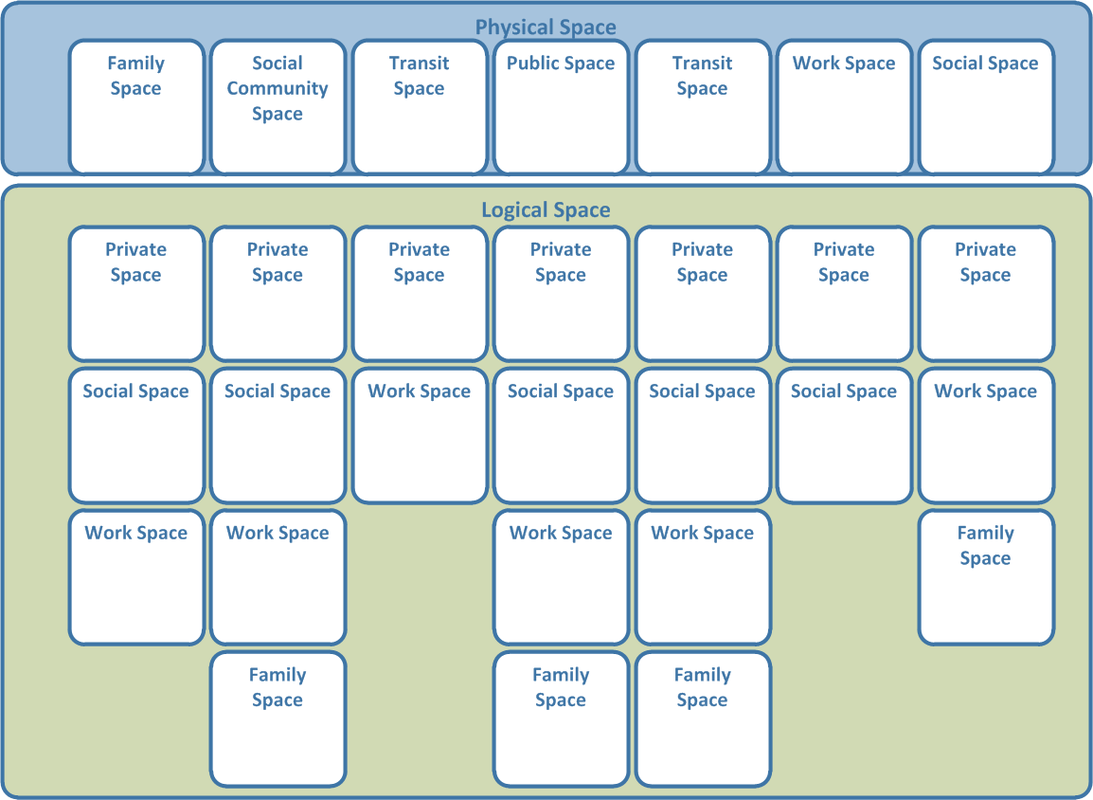
Space item 2 to 4 are physical in nature. Cyberspace is a whole different way in which the world of information is organized. Logical space is a lot more intimate and personal - its the space that the mind wanders into. For instance, while the body may be in a certain physical setting (e.g.  public transport space), the mind could be wandering off into a logical realm. A logical space is the context in which the mind operates - e.g. I might  be thinking about the alarm system at home while attending a technology briefing by a vendor. For the individual, a space is where one devotes the mindful-self. This could be the family, the community, career, etc. In a less connected world, we would probably have to physically move between spaces to be part of these groupings. For instance, in a typical day, we move from family space (home) to public space (walkways, parking, roads, etc.) before spending the rest of the day time in the office (workspace). 
Picture
In the highly connected and informed world, we seem to mind shift between spaces. We can read, organize or even participate in social events online while we are working; we read and respond to email and meeting invites while we are at home; we monitor the movement of our little children out of safety concerns regardless of our , etc .

Concept of Sub-spaces
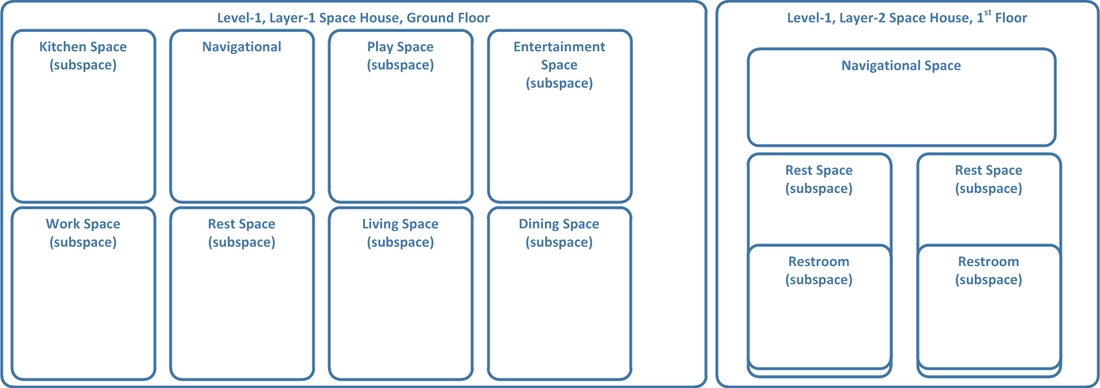
Spaces (physical or logical) are often subdivided into functional spaces - e.g. living room, bedroom, bathroom, etc. These functional spaces are called sub-spaces. Webpages are divided into contact page, product page, corporate page, etc.

Concept of Levels within Spaces or Subspaces
A level-1 space provides the platform needed for level-2 subspace to exist. Each subspace can be further subdivided into smaller spaces or will be the platform for "systems" to be hosted.
Picture
Types of Space
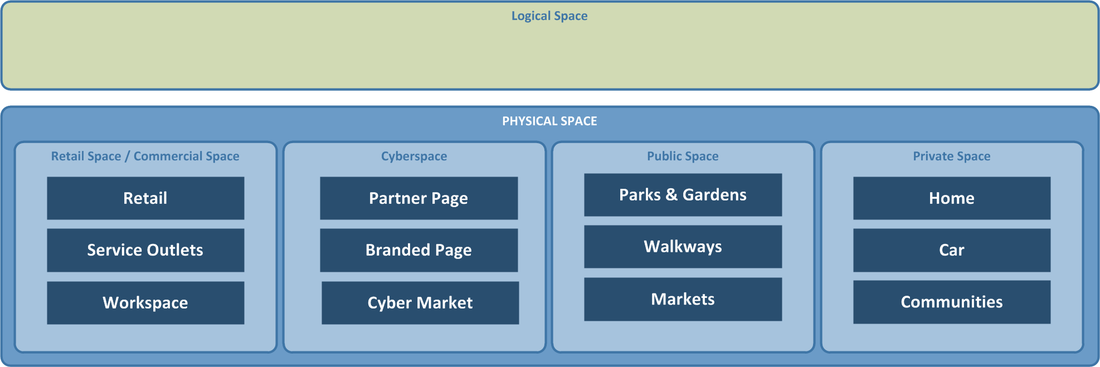
There are generally 4 main types of 'physical' space (see diagram below). While a person can be in one physical space  at a time, the mind may operate in a logical space separate from the physical space. For instance, you might be in a retail mall staring at an attractive product. Your mind could be wandering off into a personal space where you imagined yourself using the  product. The logical space creates relevance between the physical world and the mind.
Picture
The Concept of Systems
While space gives us a concept of people interacting with the environment, the concept of system provides the bridge between human and their environment. Humans have long adapted and mastered the skill of tool making. These very tool now forms the basis of the productivity systems that supports our living needs. With R3MAGICS, the tools that we have forged is again evolving and enabling a highly automated lifestyle.
In its origin, our system of intelligence and knowledge is no more than paper and pencils. That has its limitation in adapting to the situation-specific needs.
A system is a construct of 3 essential ingredient:
  1. People and processes
  2. A geo-physical asset 
  3. An information system component
Any of the 3 essential ingredient can be participant in multiple systems. For example, air conditioners as active assets can be part of  comfort systems or hygiene and healthcare system at the  same time.
As we shift between spaces, we need the productivity system to follow us into the different spaces. 
In retail hospitality, some of the systems were supplied to shoppers in the form of Customer Engagement Systems. These were in the form of comfort, caring, entertainment, record, etc. mostly considered as basic to human needs.
For instance, Apple IOS new wifi calling feature can be viewed to appeal to the financial management system of a customer as it allows a users to utilize wifi (usually at no charge) to make voice calls.

Another example is the increasing popularity of mobile payment solution at retail checkouts. This approach appeals to the customer by improving the following personal system experience:
  1. System of Time Management - allowing faster checkouts and reduced queue time
  2. System of Financial Management - integrated to the personal cloud financial data, a mobile checkout system allows one to see the financial transaction on their mobile system
  3. System of Record - provides e-receipts and a more efficient way of retrieving past transaction info. Some retailers may even allow a user to view their loyalty reward points through the same mobile app.

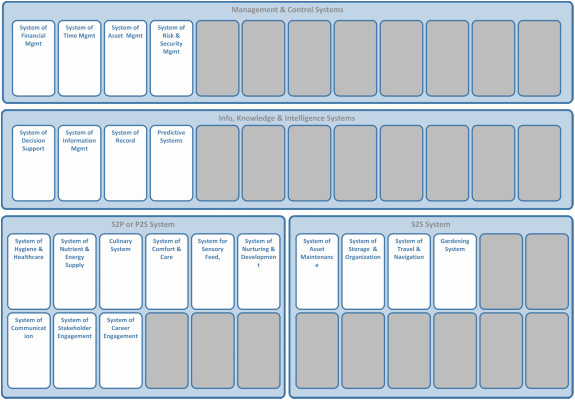
There are systems that take care of people. There are also system that takes care of system or the environment. Hence:
  1. System-to-System (S2S) - where the endpoint is always anything but a person (it could be animate or  inanimate object too)
  2. System-to-People (S2P or P2S) - the endpoint is always a person

Types of System
There are at least 5-types of systems:

  1. Private-Home systems
  2. Enterprise or Commercial Systems
  3. Community Systems
  4. Public Systems  
  5. Municipal systems
  6. Government systems
Picture
3 Tiers within each System
We derive a universal tiering approach in order to classify the type of personal system by borrowing the 3-tier concept from building architecture design. In building architecture, the  three tiers are:
  1. Load avoidance or rejection system - non-moving structure of a building. This is also the physical space boundary.
  2. Natural energy system - e.g. natural ventilation such as evaporative cooling
  3. Mechanical & Electrical system - e.g. air-conditioning
Passive system should have the largest installation and form the foundation of a pyramid for which second and third tier resides. The second tier system is second response system to the challenge should take middle position in the pyramid. And lastly, the active cooling system should require the smallest installation to create sustainable living but create meaningful impact to the target actor.
We expand on this tiering concept to center around the person itself:
  1. Tier 1 - Structural system (SS)
  2. Tier 2 - Passive System (PS)
  3. Tier 2 - Active intervention system (AIS)
  4. Tier 3 - Follow-me systems (FMS)
For instance, as part of sound barrier systems,  the acoustic walls and partition within the house provides the boundary and is part of tier 1 - structural communication barrier system. Tier 2 passive system may then consist of curtain system that further acts as additional sound barrier. Tier 2 AIS for communication consist of home PABX, PA system, door & window opening. Tier 3 FMS for comms consists of mobile phone system, wearbles, etc.

AIS systems must at least have some decision capabilities for it to perform intervention work. In the face of R3MAGICS, AIS system are now bundled with intelligence over the cloud. 
Picture
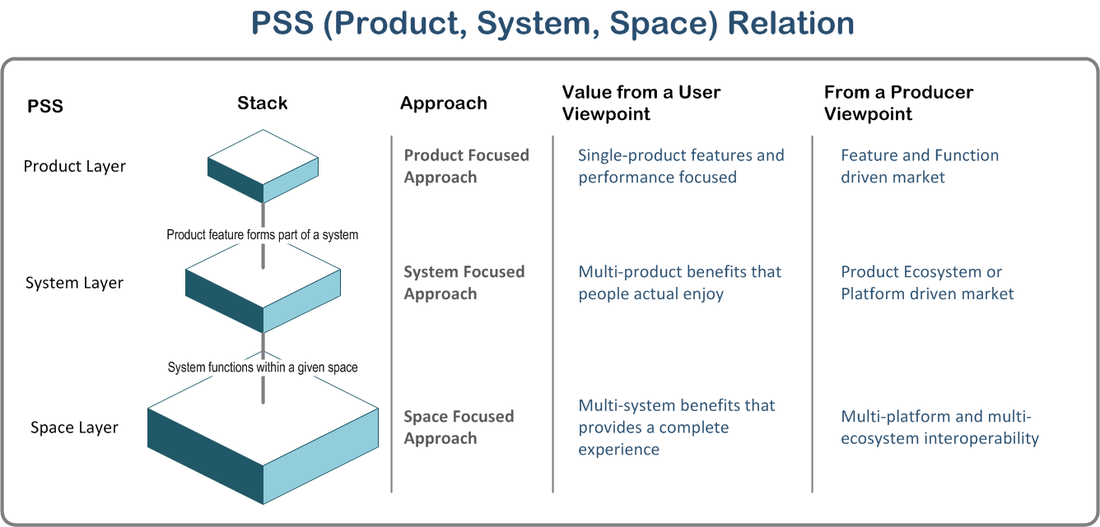
An Asset (i.e. product) in the Context of System
As mentioned in the Concept of System section, an asset (from an ownership viewpoint) or product (from a seller viewpoint) is a key functionality provider within a system. A product can be classified based on its state of readiness (to use):
  1. Unfinished Goods - Assets in its raw state that requires additional efforts to prepare it for usage or consumption.
  2. Semi-finished Goods - Assets that is in its semi-ready state and requires some efforts
  3. Finished Goods - Assets that is ready to use and requires no additional efforts
A product consists of its primary function. These function rely on specific energy adaptation, capacity, performances, and other characteristic to give it an overall functional value. A product may perform secondary functions, for instance, ionizing air-conditioners or inverter air-conds. Lastly, these products like any tools require care and maintenance adding to the lifecycle cost of using the product. A product may play a functional role in more than one personal system.
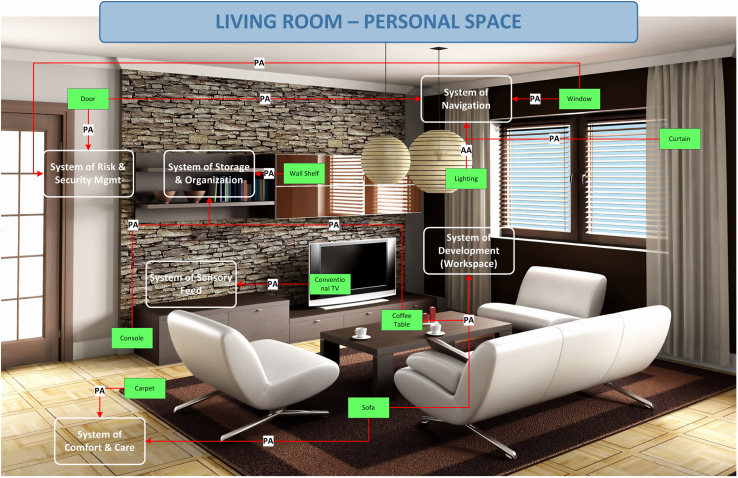
A sofa as a product asset can participate in multiple systemic roles. Within a given space, it can be part of:
  1. comfort system or
  2. transit & navigation system or
  3. storage & organization system or
  4. socialization system
An asset can also be classified into 4 different tiers:
  1. Tier 1 - Structural asset (SA)
  2. Tier 2 - Passive Asset (PA)
  3. Tier 2 - Active Assets (AS)
  4. Tier 3 - Follow-me Asset (FMA)
Picture
Concept of Space Shifting
Prior to the internet and mobile communication technologies, we are mostly passive consumer of services. We are not able reach out to our personal productivity system when we are outside our personal or home space. This however has changed in the advent of the internet and mobile technologies. With consumer bringing along their own devices wherever they go, it is now possible for them to reach out to these personalized systems remotely. This lead to the ability to constantly switch between spaces - e.g. between personal productivity and professional productivity. This creates a phenomenon called space shifting. 
Customer gets engaged actively with their own personal system. Business have to pursue a social route to continue to keep customers engaged.
Concept of Systemic Shift
Systemic shift occurs when the systems itself moves to a different tier. A passive system will become an active system by adding a systemic product that is capable of environmental or occupancy detection, decision making and response system. 
1 Comment
Ecommerce Search link
1/26/2025 11:08:13 pm

Nice Blog! Keep posting and upgrading our knowledge. Ecommerce search enhances the online shopping experience by helping customers quickly find products through search bars, filters, and advanced features like autocomplete and voice search. AI-driven search improves results based on user behavior and preferences. Faceted search and natural language processing refine the process, offering accurate and relevant suggestions. Effective ecommerce search reduces bounce rates, increases conversion rates, and boosts customer satisfaction by ensuring users can easily discover products, ultimately driving sales and improving the overall shopping experience.

Reply


Leave a Reply.

    Background

    Using a combination of StAF and R3MAGICS, this blog post provides architecture analysis of the trend and major players in the retail market. R.3.M.A.G.I.C.S is short for Robotics, 3D Printing, Mobility, Analytics, Gamification, IoT, Cloud and Social platform. It encapsulates the key elements that will change the social-economic fabric in the coming years. StAF is short for Strategy-driven Architecture Framework.

    Archives

    March 2017
    September 2015

    Categories

    All

    RSS Feed

Powered by Create your own unique website with customizable templates.
  • Home
  • DIGITAL & SMART
  • Banking
  • Communication
  • Retail
  • Models
  • About
  • Contact